A=1 Discrete Causal Lattice
Geometry first. Geometry forces physics. Geometry axiomatizes physics.
The A=1 discrete causal lattice is not proposed as the literal microscopic structure of the universe. Instead, it is a mathematically defined geometric object whose intrinsic constraints induce conservation laws, symmetries, and interaction patterns reminiscent of known physics.
My research program investigates the expressive power of this object: what physical structures it can encode, what symmetries it supports, and how far its induced geometry can be pushed toward reproducing the Standard Model and general relativity.
This is an exploration of mathematical capability, not an ontological claim.
A framework worth taking seriously must be able to be wrong — so this program treats falsifiability as something to earn and search for, not to assume. The claims that could currently kill the framework, calibrated against existing physics, are collected in the claim map’s standing falsifiable predictions — the one place the program commits to falsifiable claims. Predicting genuinely new physics, rather than recovering known physics, is a further ambition gated on the forthcoming mathematics papers and the A=1 nuclear-chemistry work — and is not claimed until it arrives. Elsewhere, the program asserts mathematical capability, not measured confirmation.
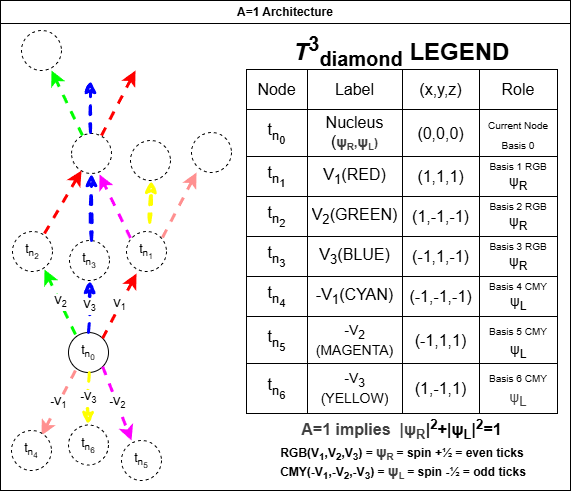
The A=1 Discrete Causal Lattice (DCL) program takes a single conservation law on a discrete-spacetime bipartite octahedral lattice and uses it to recover emergent Lorentz invariance, locate the origin of the Standard Model gauge group, recast gravity as a clock-density effect, and predict a quantum analogue of the Roche limit. Successive papers in the series advance a single methodological arc:
- Geometry first (Paper I) — the substrate is a discrete causal lattice, and the rest follows.
- Geometry forces physics (Paper II) — the Standard Model gauge group is recovered from a single conservation axiom, with containment established and exact equality left open.
- Geometry axiomatizes physics (capstone, in progress) — the methodological arc is closed into a Hilbert-Sixth-shaped axiomatization.
This site is the public surface for the series. It tracks news, hosts research artifacts that don’t fit a paper-figure shape (3D models, animations, interactive visualizations), and gives an entry-point for readers, collaborators, and endorsers.
Where to start
- Papers — the canonical series, with Zenodo DOIs, arXiv links, and repository links.
- Research artifacts — 3D models, visualizations, interactive demos.
- News — releases, deposits, talks, milestones.
- Essays — short-form methodological writing.